
Passing Places
Rules for the road and life

With Building Bridges Word by Word ever in my mind, words that speak to what divides us and what brings us together continually jump out at me. Though my reading of them may be far from their intended meaning, I appreciate how they prompt me to see what is and what might be.
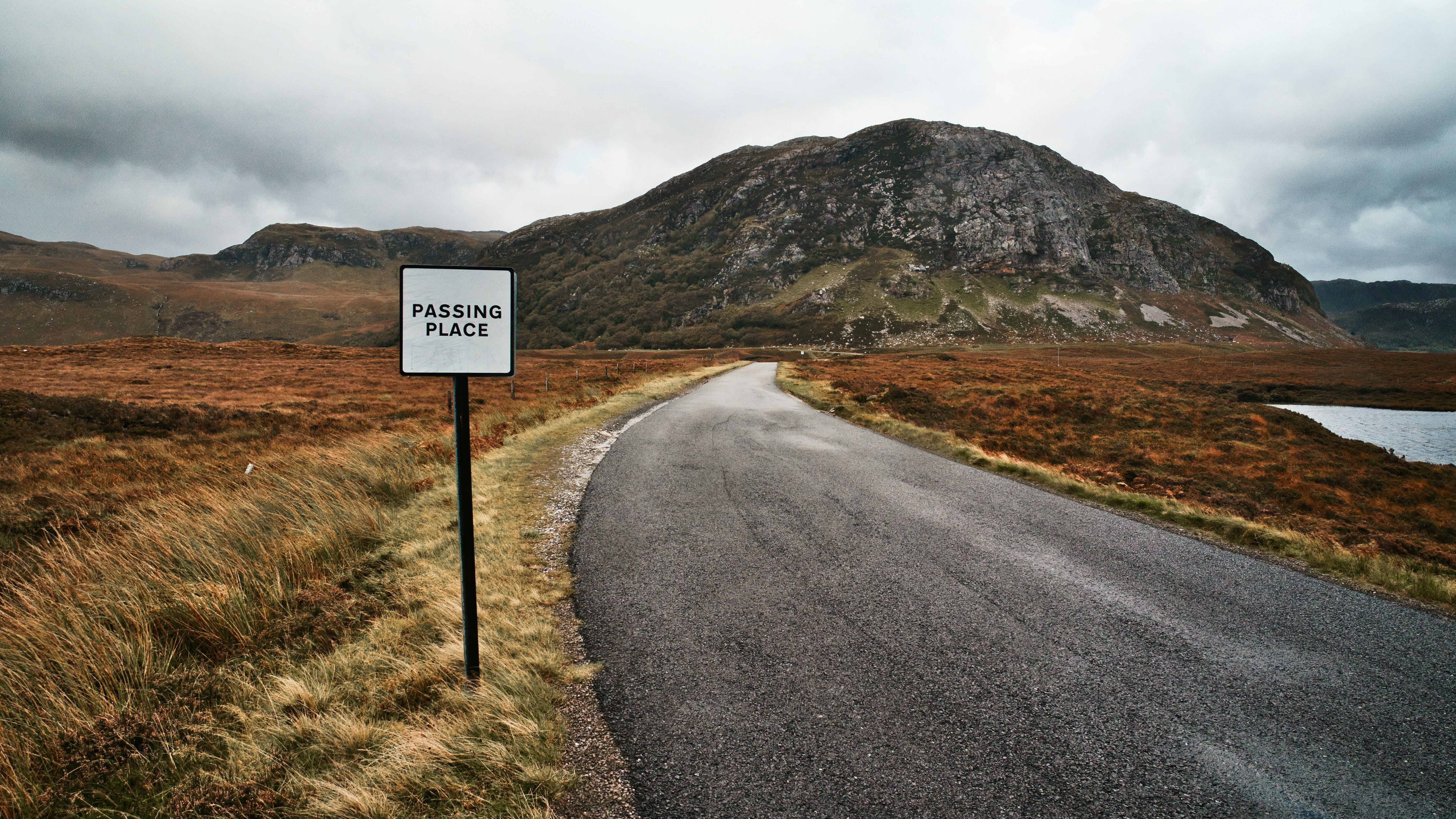
In September, my husband and I had a terrific time traveling in Scotland. In addition to the spectacular vistas, beautiful historic sites, kind people, delicious meals, tasty ales and Scotch whiskey, I was quite taken by their “Passing Places.”
Passing Places
Reportedly, there are 2500 miles of single-track roads in the Scottish Highlands. Though having traveled only a fraction of the region, we frequently found ourselves on these one-lane, narrow roads, often with beautiful scenery and steep drop offs – both guaranteed to take your breath away.
The size of the population and the amount of traffic don’t warrant carving out a second lane. I appreciate their prioritizing beauty, nature, and sheep over cars!
Yet, there are many times when one encounters a car approaching from the other direction. Their answer? Create a “passing place” a narrow bit of dirt, gravel, or pavement ever so slightly extending the side of the road. Most of these spaces were not wide enough for our entire car to pull in (and ours was a small one), but they did give just enough space for us to let the other car to pass by.
These spaces occur on a somewhat frequent basis (about 100-400 meters), often marked with a “Passing Place” sign. When a sign isn’t in sight, the strategy is to keep on the lookout for a slight, planned or not, expansion of the road that you can take advantage of.
In passing, drivers regularly give a thanks with a wave - acknowledging the generosity of the other. It quickly feels like you’re part of a collaborative system, a community, that makes it all work.
In looking online, I found that others were also intrigued by this unusual form of road design – and what it said about us and each other.
Firstly, the golden rule is to use passing places wherever possible. [So nice to hear that the golden rule is still a thing.] Don’t be tempted to pull onto the verge, as this can cause damage to the road and to the surrounding landscape... Sometimes, you’ll find that you spot a car in the distance, and neither of you are beside a passing place and you both keep driving. It can help to indicate, to show that you intend to pull over at the next passing place, or flash your lights to the oncoming driver to let them know you intend to let them pass. …. Finally, pay attention. Sure, the scenery is amazing, and there aren’t many cars sharing the road, but it’s very common to turn a corner and find a flock of sheep or a herd of Highland cows standing in the middle of the road. They don’t obey the highway code, and they won’t reverse, so drive safely. If you’re stuck behind them, you’ll just have to be patient and hope they move out of your way!
Another intrepid driver notes:
1. Passing places require far less land.
As Strong Towns advocates know, land is the base resource from which community prosperity is built and sustained; it mustn’t be squandered. Widening a GWR American style would consume an enormous amount of land, especially compared to simply adding a little extra pavement every few hundred yards for a passing place.
2. Passing places encourage neighborliness.
No, seriously. When someone lets you go by, you’re expected to wave. When someone waves to you, you’re expected to wave back. I got so caught up in this ritual that when I thought someone hadn’t waved, I got mildly annoyed. “Tourists,” I grumbled…
3. Passing places slow drivers.
Officially, the speed limit on most single-track rural roads is 60 mph, but I rarely achieved that speed… Drivers go slow because if a car in either direction is driving too fast, both are in danger of serious damage. You drive slower, looking ahead to see, as best you can, if other vehicles are coming toward you and where the next passing place will be….
I was reminded that the best way to slow cars isn’t by enforcement, speed limits, or even traffic signals—it is through road design. There are multiple design factors compelling drivers in Scotland to slow down. These include the give-and-take of yielding, the inherent complexity of roundabouts, and the formality of passing places. The perceived risk of a single-track road requires drivers to lighten up on the gas. Even the two-lane streets and roads are often narrower in Scotland than they are here. The best advice I got from Rick Steves about driving in Scotland was this: “Adjust your perceptions of personal space: It’s not ‘my side of the road’ or ‘your side of the road,’ it’s just ‘the road’—and it’s shared as a cooperative adventure.”
These roads call for patience, etiquette, and the recognition that we all have places to go, but don’t always need to get there quickly. And really the best way to share the road, and enjoy the ride, is to leave a little space for others to go by. Even when our destinations and the view of the road is different – we still need to share the road.
Seems to me that fits for how we drive on the road and how we live, or at least co-exist, with others.
i remember so well those very narrow roads and passing places, and the miracle of generosity and seamless travel that resulted! thank you!