
This Too Shall Pass
Riding out the storms

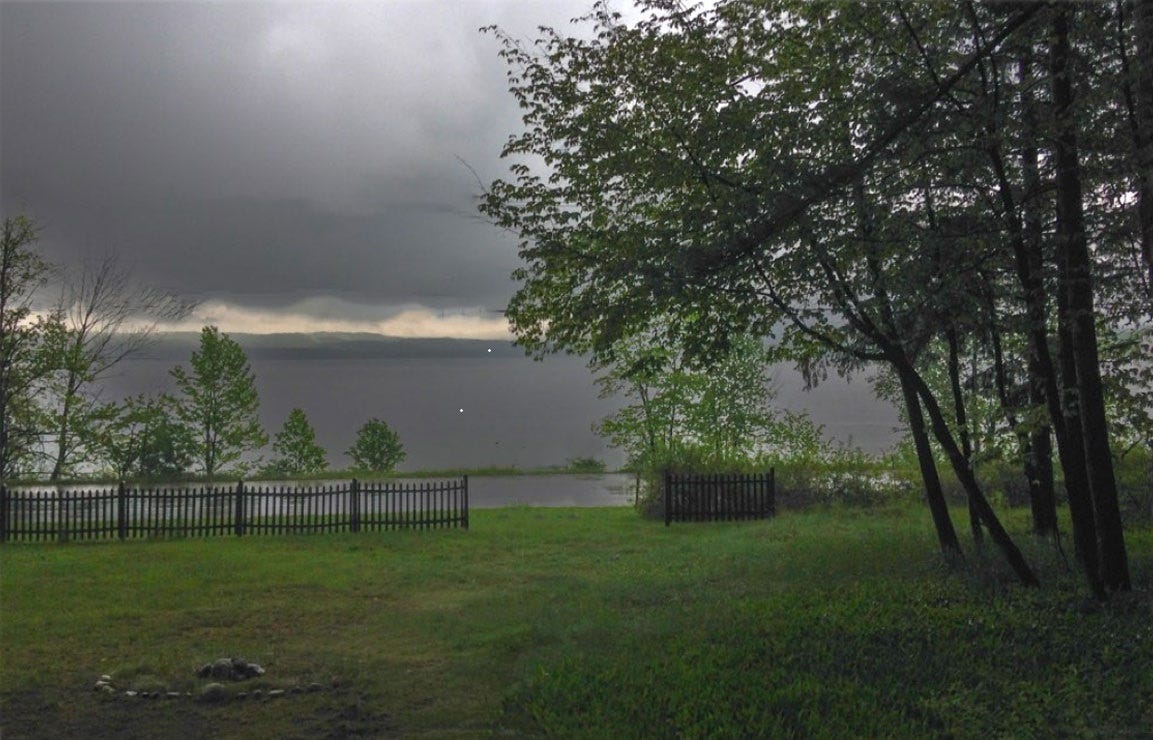
THE STORM WAS DAZZLING
The storm
Was dazzling,
Marching toward us
On the lake,
The water black
And wildly unsettled
Swirling and disturbed,
Lightning splitting the dark,
Outlining the hills,
The wind lifting water spouts
Then dousing them.
As we in our rockers on the porch
watched this unfolding,
His daughter called,
She in a meltdown,
Her own storm from her work
Swirling in her head
Two thousand miles away.
Her dad, watching the weather
Unleashing itself
In front of us,
From the safety
Of the porch of this 100-year old cottage,
Helped her realize she too
Was safe
Although the storm was raging.
Her voice settled down
Into a calmer tone,
Long before the last
Lightning strike
Split the air
Across the way.
— Judy Brown, July 24, 2025
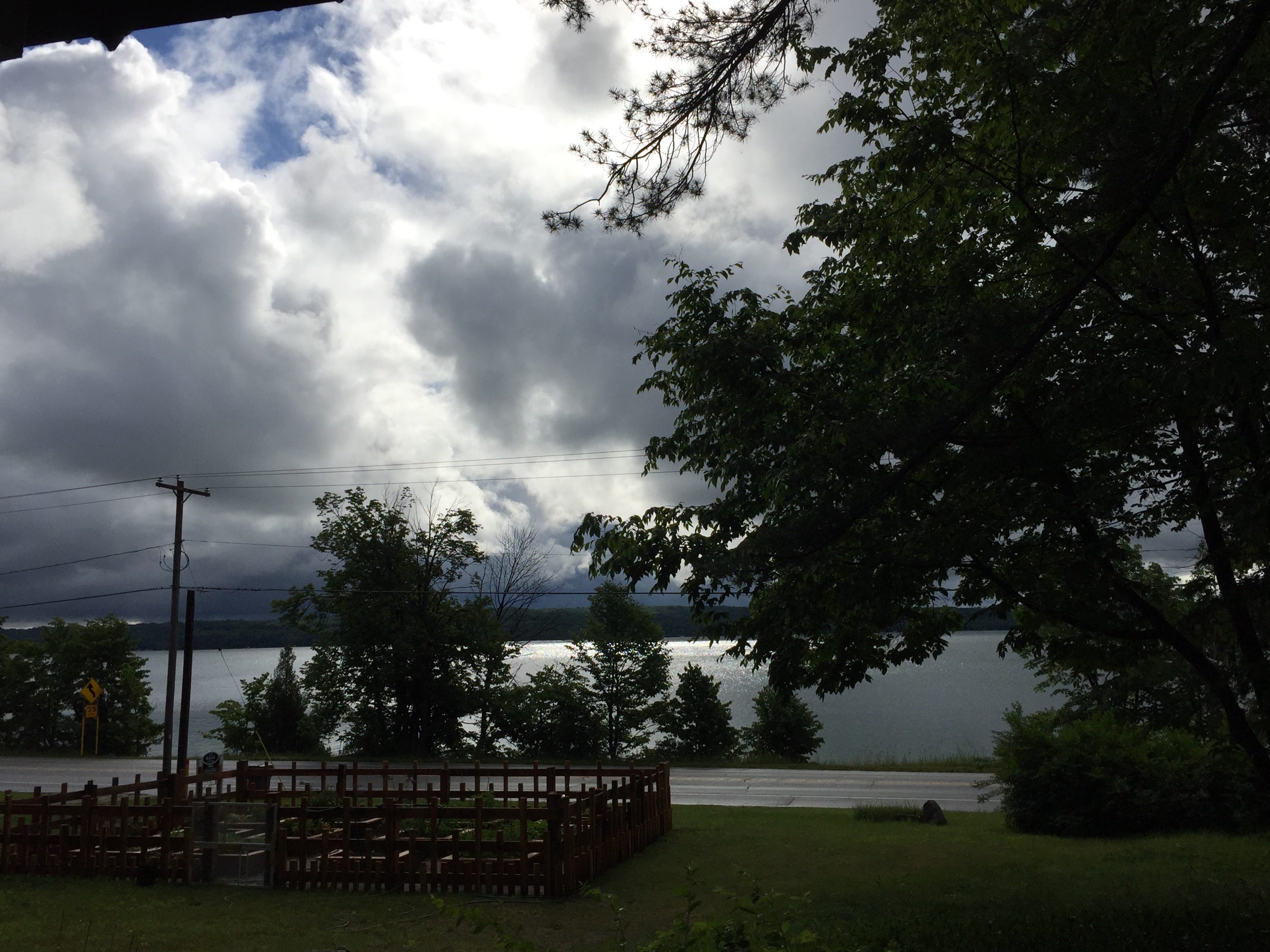
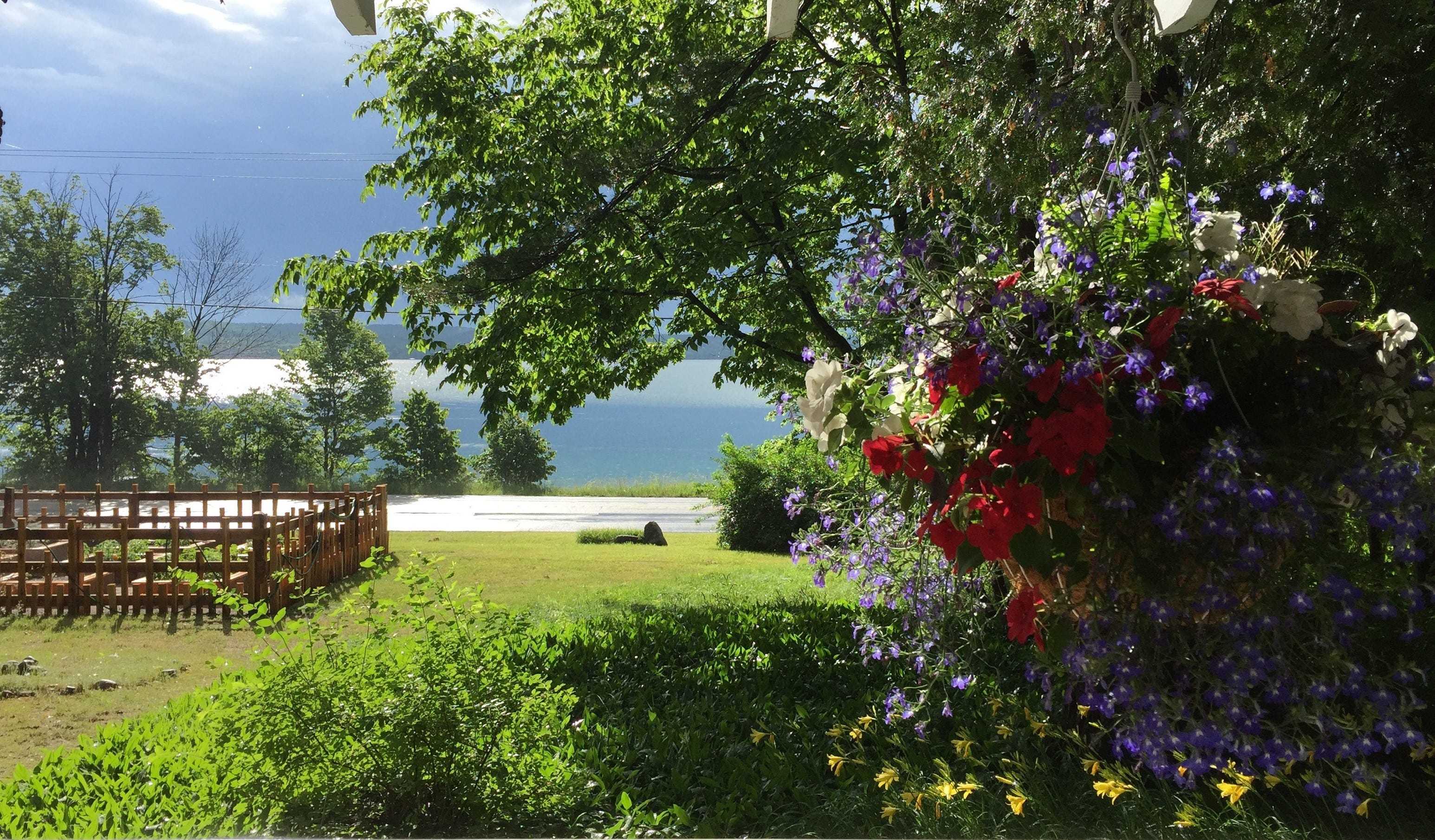
Many thanks to Judy for her permission to share her terrific poem and the wonderful pictures that captured the storm.
Her poetry book, No One Swims Alone, is this month’s Book Giveaway. Paid subscribers and those whose submissions are posted on our Substack by March 31st will be entered into a drawing for a signed copy of her book!
This too shall pass
As with all storms — natural, personal, and yes, even political — it eventually passed. But in the midst of a storm, it can be hard to believe.
“This too shall pass.”
I have often said this to myself and others. I find it soothing, a way to calm my nerves. It is also a quiet nod to my optimist worldview - handed down to me by my father - that by and by things will work out.
But beneath the phrase, I can also hear a note of resignation. A sigh. Yes, this too shall pass. But in the meantime, we must deal with the storm as best we can, and the next one, because we know other storms will come.
While I reach for this saying largely for comfort, I realize that I also use it to distance myself from the storm – from those who created it and the damage it may cause. To protect myself from feeling too much or even feeling somewhat responsible.
Saying “this too shall pass” to myself, enables me to turn my back on the onslaught and focus on other things that I feel I can impact or perhaps even change. While that’s not necessarily a bad thing, I see how disassociating myself from the storm - surely it will pass! - keeps me from doing much to lessen the damage. In doing so, I suspect I’ve undermined the saying’s message, reduced it to its lowest possible meaning.
All this had me wondering about the origin of “this too shall pass” and if there is more it can say to me, to us, to our time. So, I jumped down the rabbit hole.
There I found Joel Neff, Learned Substack (well worth a look), where he recounts the story of how the saying came to be:
The king called his philosophers, wise-men, counselors, and fools to him.
“Create for me a ring such that when I am happy, and I look at the ring, I will become sad and when I am sad, I will look upon the ring and be happy.”
The philosophers, wise-men, counselors, and fools went away for six months. When they returned, they gathered before the king and presented him with a simple, silver ring adorned only with a short phrase engraved in simple characters.
The king held the ring up to his eyes, the better to read the inscription. He turned the ring slowly in his hands so that the characters appeared one by one. He considered each in turn until, at long last, he had read the full length of the ring.
He nodded once, accepting the words of his philosophers, wise-men, counselors, and fools: “This, too, shall pass.”
For a longer, more detailed version of the story, read Alex Hohajer’s “This Too Shall Pass: An “English-language retelling of the 13th-century Persian fable that birthed a famous adage” essay on Medium.
Ralph Keyes, The Quote Verifier: Who Said What, Where, and When, traces the saying from its origin in Persian poetry, to Jewish folklore, to English fables, and beyond. “The same basic story, typically featuring ‘an Eastern monarch,’ had appeared in American periodicals since at least 1839.”1
And from there, it was picked up by many, including Abraham Lincoln, who used it in a speech in Milwaukee, Wisconsin on September 30th, 1859.
It is said an Eastern monarch once charged his wise men to invent him a sentiment to be ever in view, and which should be true and appropriate in all times and situations. They presented him the words, “And this, too, shall pass away.” How much it expresses! How chastening in the hour of pride; how consoling in the depths of affliction! “And this, too, shall pass away.” And yet, let us hope, it is not quite true. Let us hope, rather, that by the best cultivation of the physical world, beneath and around us, and the intellectual and moral worlds within us, we shall secure an individual, social, and political prosperity and happiness, whose course shall be onward and upward, and which, while the earth endures, shall not pass away.2
Leave it to Lincoln, someone who was plagued by depression and who would live through the storms of the Civil War, to find the wisdom in impermanence. AND optimistically call on us to hope that we could not only get through the storms, but we could do better. We could cultivate “intellectual and moral worlds within us” and secure “individual, social, and political prosperity and happiness.”
Let’s go onward and upward and help make that happen.
What’s Your Story?
What does “This too shall pass” mean to you? Does it give you comfort in hard times? Does it chasten you in the hour of pride? Does it distance you from the storm, or make you more determined to work for a better outcome?
Please share your thoughts in the comments below. Or consider sharing a slightly longer version (up to 250 words) and we’ll post it here on Substack and on the Building Bridges Word by Word website.
Why write? Your interpretation of “This too shall pass” may help another person to find solace or strength to make a difference.
Plus, taking time to write a reflection is a good way to give yourself a break from the storms - something we all could use these days.
Check out the guidelines for your submitting your story. Questions? Email mscribner.buildingbridgeswbw@gmail.com. I look forward to working with you to share your story.
Keyes, Ralph (2006). The Quote Verifier: Who Said What, Where, and When. Macmillan. pp. 159–160.
www.nps.gov/liho/learn/historyculture/amerfuture.htm
What a lovely gift that lecturer gave to your husband and you! Thanks for sharing your story.
Beautiful words that are and were my own experience over 30 years ago. I experienced home sickness for 6 years in my mid 20’s and my hubby confiding in a lecturer where he was studying because he was worried about me and the lecture used these very words 🙏